
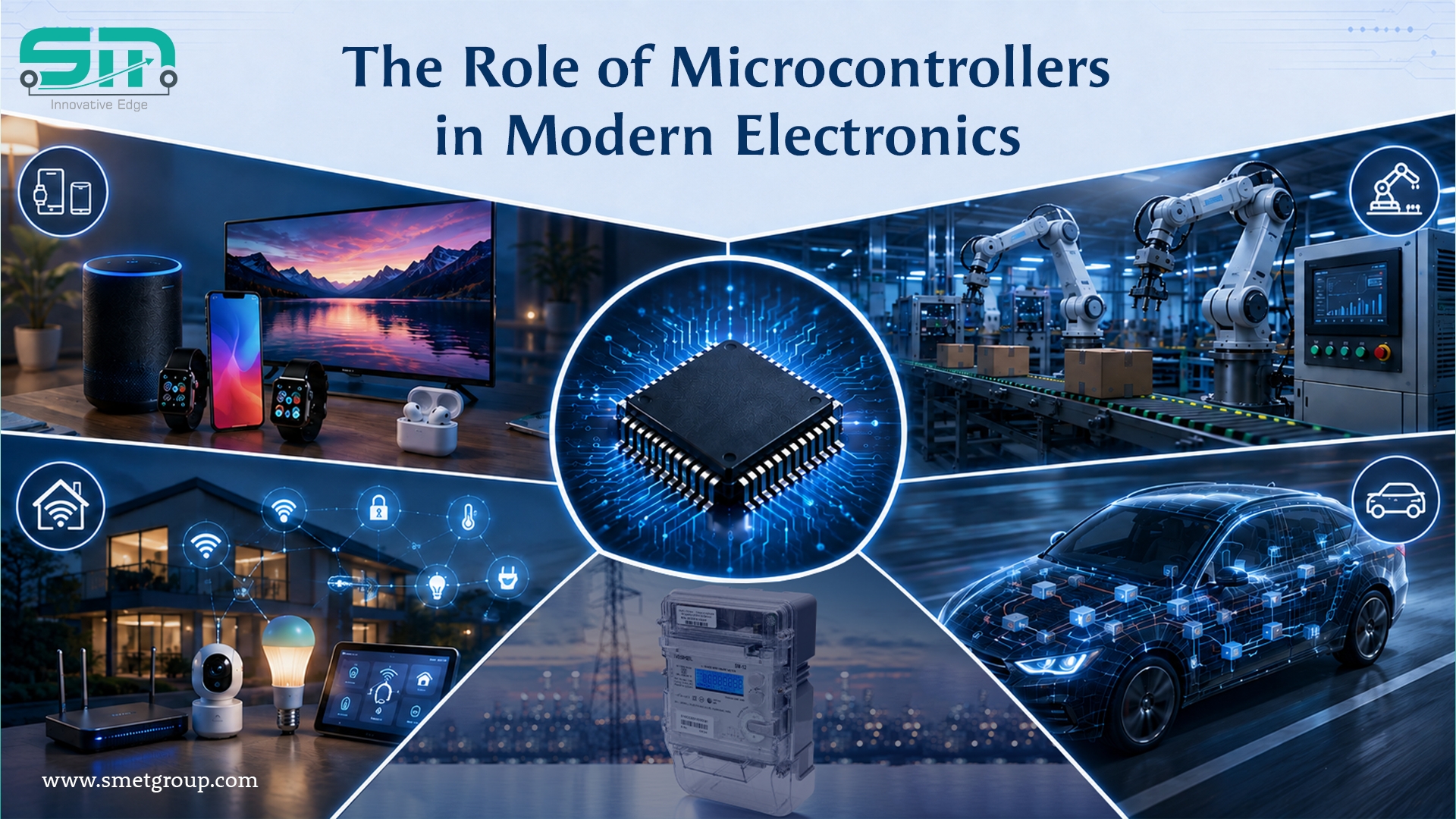
Microcontrollers have revolutionized the electronics industry by allowing devices to process data, make decisions, and interact with their environment in real time. From household appliances to advanced industrial equipment, they improve performance, reduce human intervention, and enable intelligent automation.
In this blog, we will explore the applications where microcontrollers play a major role in modern electronics.
1. Powering Smart Consumer Electronics
Microcontrollers are widely used in everyday devices such as washing machines, microwave ovens, smart TVs, air conditioners, refrigerators, and wearable gadgets.
2. Enabling Industrial Automation
Manufacturing industries rely on microcontrollers for machine control, robotics, process automation, and real-time monitoring.
3. Enabling IoT and Smart Devices
Microcontrollers are the foundation of Internet of Things (IoT) devices. They collect sensor data, process it locally, and communicate with cloud platforms via Wi-Fi, Bluetooth, Zigbee, or LoRa.
4. Driving Automotive Electronics
Modern vehicles contain dozens of microcontrollers that control safety, performance, and comfort features. Modern vehicles contain numerous microcontrollers that manage engine functions, braking systems, airbags, climate control, lighting, infotainment, and driver-assistance features. Multiple microcontrollers often communicate with one another through automotive communication networks, allowing different systems to work together efficiently.
5. Real-Time Processing
Many applications require immediate responses to sensor inputs. Microcontrollers provide deterministic, real-time control for tasks.
Microcontrollers are the backbone of modern electronics, enabling intelligent, automated, and connected devices across industries. As technologies such as IoT, electric vehicles, Industry 4.0, and edge AI continue to evolve, microcontrollers will remain essential for building smarter, faster, and more energy-efficient electronic systems. Their versatility, affordability, and continuous innovation make them indispensable in today's embedded applications and future technological advancements. To read more blogs, Click Here